
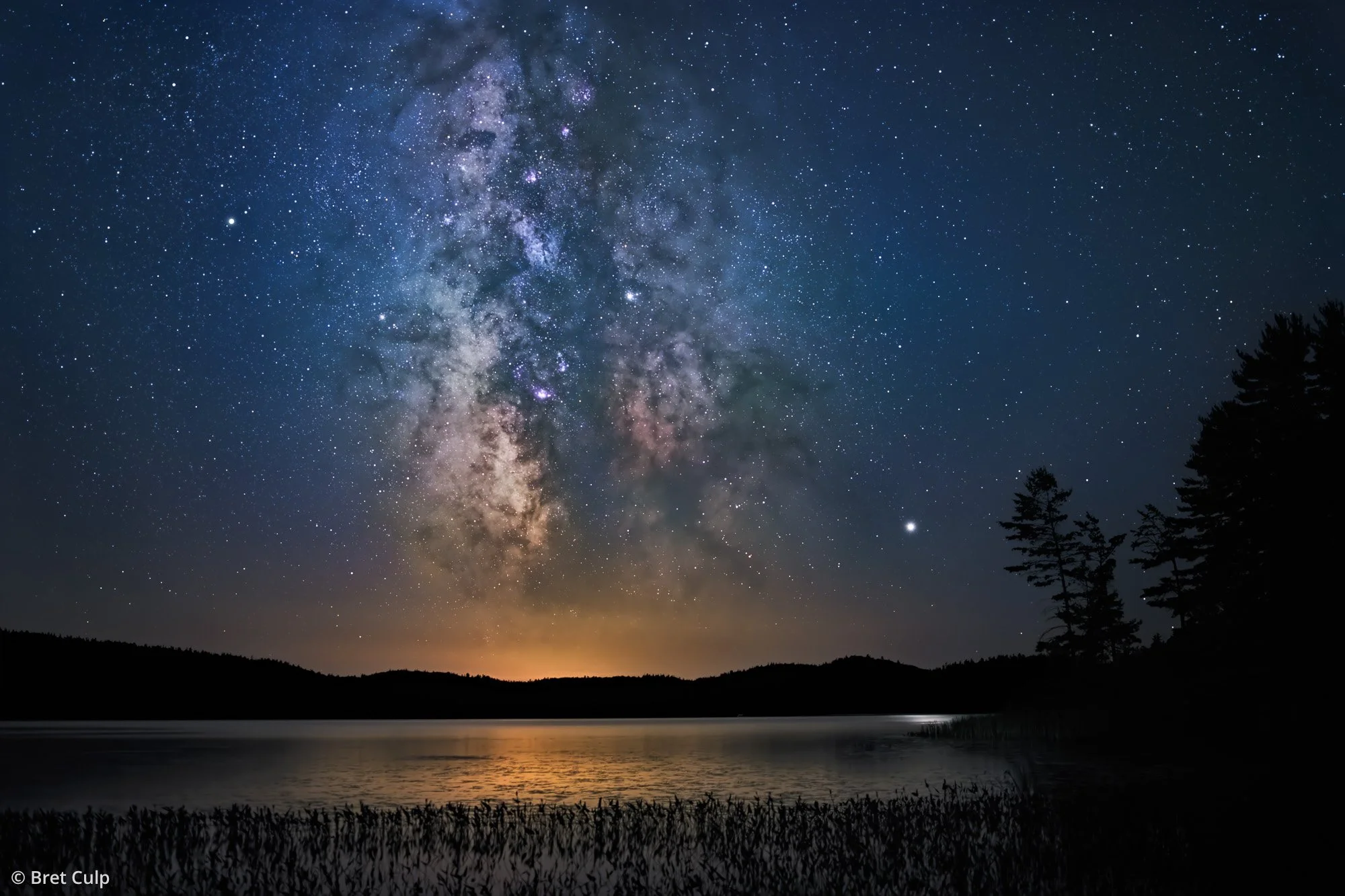
Milky Way, Jupiter and Saturn, Algonquin Park, Ontario, Canada, July 31, 2019
Astronomical Context
The Milky Way is our home galaxy, a spiral system with a disk of stars spanning more than 100,000 light-years across. From Earth, the Milky Way appears as a faint band of light because we are looking through the galaxy from within its disk, seen edge-on from our position inside it.
The galaxy is estimated to contain between 100 and 400 billion stars, yet even from a perfect dark-sky location, the unaided eye can see only a few thousand stars at a time. The nearest star beyond the Sun, Proxima Centauri, is about 4.24 light-years away. At the centre of the Milky Way is Sagittarius A*, a supermassive black hole with a mass equivalent to roughly 4.3 million Suns.
The Milky Way does not rotate like a solid wheel. Stars and gas orbit the Galactic Centre at different rates depending on their distance from it. Our solar system takes about 240 million years to complete one orbit around the galaxy, a timescale often called a galactic year. Since the Sun formed approximately 4.6 billion years ago, it has completed only twenty such orbits.
Beyond the Milky Way, Hubble-based estimates suggest that the observable universe may contain two trillion galaxies, many of which are too faint or too distant to be seen with present-day telescopes. In this photograph, Jupiter and Saturn appear within the same field of view as the Milky Way, placing a quiet Ontario shoreline in relation to planetary, galactic, and extragalactic scale.

Room view
Milky Way, Jupiter and Saturn, 2019
Milky Way, Jupiter and Saturn
Algonquin Park, Ontario, Canada, 2019
About the Print
Limited Edition Information
Prints are produced to order as signed, numbered limited editions using archival processes, museum-grade papers, and premium substrates. Each print is accompanied by a certificate of authenticity. Available sizes, edition status, framing options, and acquisition details are provided upon inquiry.
| Size (Inches) | Edition Size | Artist Proofs |
|---|---|---|
| 60x40 inches | 5 | 1 |
| 48x32 inches | 5 | 1 |
| 36x24 inches | 10 | 1 |
| 30x20 inches | 10 | 1 |
| 18x12 inches | 15 | 1 |
Total edition cap: 45 prints, excluding artist proofs.
Artist proofs are reserved for the artist’s archive, exhibition use, and institutional purposes, and are not offered for general sale.
Inquire About Print
Please fill out the form, and I’ll promptly reply. Or call the number below for personalized assistance.
+1 (647) 220-6578