
Matera
Black and white photographs from Matera, Italy, including the Sassi cave dwellings, rock churches, stairways, alleys, frescoes, night streets, and ravine landscapes.
The series approaches Matera as a city of excavation and return, where ancient habitation, abandonment, restoration, and contemporary life remain visible in the same stone.

Città sul Gravina
Gravina ravine, Matera, Basilicata, Italy

Chiesa di San Pietro Caveoso
Matera, Basilicata, Italy

Santa Maria de Idris
Matera, Basilicata, Italy

Sacro e Secolare
Sassi di Matera, Basilicata, Italy

Chiesa in Pietra
Sassi di Matera, Basilicata, Italy

Casa Grotta
Matera, Basilicata, Italy

Porte
Matera, Basilicata, Italy

Sassi di Matera
Matera, Basilicata, Italy

Strati di Storia
Sassi di Matera, Basilicata, Italy

Sentinella delle Pietre
Sassi di Matera, Basilicata, Italy

Rovine di una Chiesa Rupestre
Matera, Basilicata, Italy

Casa Grotta di Notte
Matera, Basilicata, Italy

Città di Matera di Notte
Matera, Basilicata, Italy

Passaggio di Notte
Matera, Basilicata, Italy

Disintegrazione
Matera, Basilicata, Italy

Affresco #1
Matera, Basilicata, Italy

Abbi Pietà di Me
Matera, Basilicata, Italy
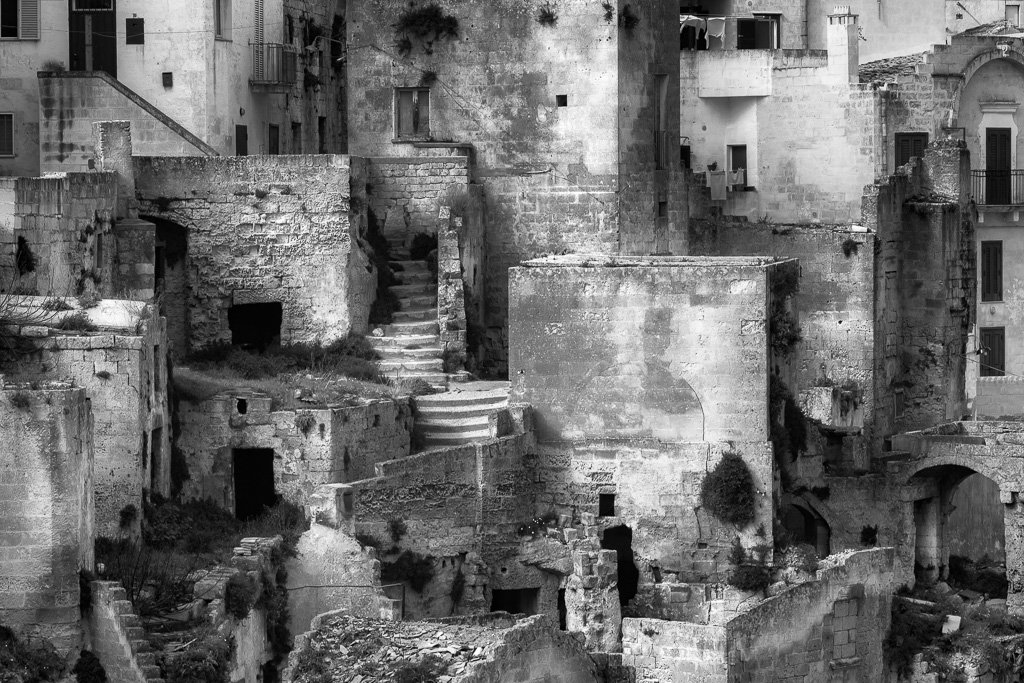
Architettura Antica
Sassi di Matera, Basilicata, Italy

Labirinto
Sassi di Matera, Basilicata, Italy

Orizzonte di Matera
Matera, Basilicata, Italy
The ancient cave town of Matera, Italy, illustrates the cycles of growth, decay, and renewal.
Matera originated as a Paleolithic troglodyte settlement dating back more than 9000 years. The Sassi di Matera, translated as Stones of Matera, is the most ancient part of the town – its structures are carved out of the soft limestone rock of the region. The labyrinths of buildings and passages sit on top of one another. The roof of one house may be the foundation of another or even a roadway. It's filled with tunnels and caverns with only a fraction visible on the surface, leading to the name La Città Sotterranea (Underground City). The layers of its long history are evident in the exposed cross-sections of the city, like sedimentary rock strata deposits, making it easy to imagine how past generations lived. It's one of the only places in the world where it's feasible for residents to live in the homes of their Stone Age ancestors. As such, Matera has been designated a UNESCO World Heritage Site.
The caves were a refuge for monks, nuns, and hermits fleeing the persecution of the Middle Ages Inquisitions. There are over 150 Rupestrian cave churches, many featuring impressive frescos painted by monks over 1000 years ago. Some caves are simple. Others are complex warrens with large underground chambers. Many churches were places of pagan worship before being established by Christians. Inside, the accumulation of centuries of reverence and prayer is tangible.
By the 1950s, the residents lived in poverty, sharing their homes with livestock, often without electricity, heating or running water. The state declared matera the shame of Italy; more than 15,000 citizens were forcibly evicted and moved to new housing developments above. For the next 50 years, the abandoned ancient town became overgrown and derelict as nature gradually reclaimed it.
In the 2000s, artists and bohemians started to reinhabit the Sassi, signifying the beginning of a rebirth. Cave hotels and restaurants began to open, catering to the arrival of tourists. However, unlike other such locations, Matera hasn't needed to rely entirely on tourism to sustain itself. The contrast between its ancient history and modern-day reality is striking. In a city that was once a national embarrassment, the ancient caves now house the blinking lights of computer servers, as it has become the home of several high-tech companies. Today, more than half of the Sassi is restored. Coming full circle from a national embarrassment, Matera was selected as the 2019 European Capital of Culture.